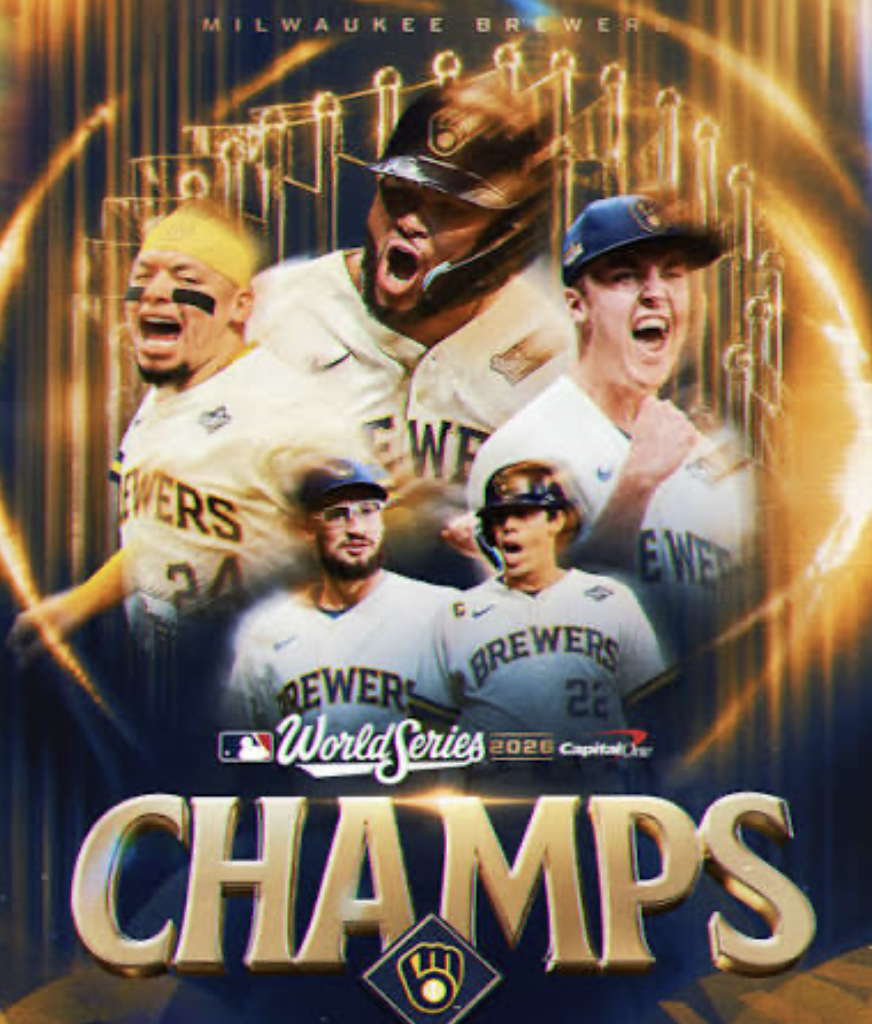
The 2026 World Series was a fascinating matchup for several reasons, but perhaps the most interesting aspect was the similarities between the two organizations competing for their first championship in franchise history. The Milwaukee Brewers and Tampa Bay Rays represented two of baseball’s most successful examples of building a competitive team without having to spend like the Dodgers or Mets. Both teams entered the Fall Classic as the No. 1 seeds in their respective leagues, marking just the sixth time since the Wild Card Era began in 1995 that the top seeds from both leagues met in the World Series. It was also the first time since 1980 that two franchises without a World Series championship met on baseball’s biggest stage.
There was a clear difference in the financial resources of these two teams compared to some of baseball’s biggest spenders. Milwaukee entered the postseason with a payroll of approximately $146.2 million, while Tampa Bay’s payroll was approximately $95.6 million. Neither organization has built its identity around handing out massive contracts in free agency. Instead, both have established a reputation for identifying undervalued talent, developing players internally, and understanding when it is time to move on from a player before his value begins to decline. MLB.com+1
The Brewers ultimately made the most of their opportunity, defeating the Rays in five games to win the first World Series championship in franchise history. After finishing the regular season with the best record in baseball at 103-59, Milwaukee carried that success into October, finishing the postseason 12-2. The Brewers went 9-1 before the World Series, including a four-game sweep of the Los Angeles Dodgers in the NLCS, before taking four of five games against Tampa Bay.
It makes you wonder just how special this team really was. Milwaukee’s championship was built on great pitching, led by Jacob Misiorowski, who emerged as one of the most dominant young arms in baseball, and an offense that consistently found ways to produce in big moments. Willson Contreras provided an important presence behind the plate, while the Brewers received contributions from virtually every part of their lineup. It was not necessarily a team built around one superstar carrying the entire organization. It was a complete team that understood how to win in different ways.
What made Milwaukee’s postseason even more impressive was its ability to avenge the previous year’s disappointment against the Dodgers. After being swept by Los Angeles in the 2025 postseason, the Brewers returned the following year and swept the same team in the NLCS. They became the first team in MLB history to be swept by an opponent in one postseason and then sweep that same opponent in the following postseason. It was a remarkable turnaround against a Dodgers organization that had become accustomed to being the team everyone else was trying to catch. MLB.com+1
The art of knowing when to sell high
Although Milwaukee deserves plenty of credit for its championship, the similarities between these two organizations extend far beyond their payrolls. The Rays have arguably become one of the best examples of how an organization can continually remain competitive despite trading away some of its most recognizable players. Tampa Bay has never been afraid to make difficult decisions, even when those decisions involve players who have helped establish the franchise.
One of the most notable examples was the decision to trade Blake Snell to the San Diego Padres in December 2020. Snell had won the 2018 American League Cy Young Award and remained one of the most recognizable pitchers in the organization. Yet Tampa Bay recognized an opportunity to acquire four players in return: Luis Patiño, Blake Hunt, Cole Wilcox and Francisco Mejía. It was another example of the Rays being willing to move on from a valuable player while his market value remained high.
That same philosophy can be traced back to the July 2018 trade that sent Chris Archer to the Pittsburgh Pirates. At the time, Archer was one of Tampa Bay’s established starting pitchers, but the Rays managed to acquire Tyler Glasnow, Austin Meadows and a player to be named later, who became Shane Baz. Glasnow and Meadows became important contributors, while Baz developed into a notable part of Tampa Bay’s pitching future.
The Rays have also made some remarkable acquisitions through their willingness to take chances on players who had yet to establish themselves in the major leagues.
In December 2018, Tampa Bay acquired Yandy Díaz and Cole Sulser from Cleveland in a three-team deal that sent Jake Bauers to the Guardians. Díaz eventually became one of the more consistent hitters in the Rays lineup, providing an excellent combination of contact, power, and plate discipline.
Then there was the January 2020 acquisition of Randy Arozarena from the St. Louis Cardinals. Tampa Bay sent pitching prospect Matthew Liberatore, catcher Edgardo Rodriguez and a draft pick to St. Louis in exchange for Arozarena, José Martínez, and a draft pick. Arozarena would go on to become one of the most recognizable postseason performers in baseball, helping the Rays reach the 2020 World Series.
Another example was Junior Caminero, whom Tampa Bay acquired from Cleveland in November 2021 in exchange for pitcher Tobias Myers. Caminero eventually developed into one of the most exciting young hitters in baseball and became a centerpiece of the Rays organization.
These are the types of transactions that make the Rays so fascinating. Not every trade works out, but their willingness to move established players and invest in younger talent has allowed them to remain competitive year after year. MLB.com+2
The 2026 roster was another reflection of that philosophy. According to MLB.com, 61.5% of Tampa Bay’s roster had been acquired through trades. That is an incredible number when considering how many different players have contributed to the organization’s success over the years. MLB.com
Milwaukee has followed a remarkably similar blueprint. The Brewers have consistently shown a willingness to trade players before their contracts become too expensive, while prioritizing player development, scouting and finding value in areas of the market that other organizations might overlook.
One of the most interesting examples actually involved the two teams competing in this year’s World Series. In May 2021, Milwaukee acquired Willy Adames and Trevor Richards from Tampa Bay in exchange for relievers J.P. Feyereisen and Drew Rasmussen. Adames became an important part of the Brewers’ organization, while Rasmussen developed into one of the Rays’ most important starting pitchers.
It is a perfect example of how two organizations can make a trade that benefits both sides. Milwaukee received an established shortstop who helped strengthen its infield, while Tampa Bay acquired a pitcher who eventually became a key part of its rotation. Neither organization was necessarily wrong in its evaluation. They simply recognized different opportunities to improve their rosters. MLB.com+1
Both teams have also benefited from excellent leadership in the dugout. Kevin Cash has been one of the most consistent managers in baseball throughout his tenure with Tampa Bay, earning two Manager of the Year awards. Pat Murphy, meanwhile, just became the first manager in either league to win Manager of the Year in three consecutive seasons. Their ability to maximize the talent available to them has been a major part of why these organizations continue to compete against teams with significantly larger financial resources.
And that is what makes the Brewers and Rays so interesting. They are not necessarily following the same blueprint as everyone else. They are not trying to win the offseason by signing the biggest free agents or committing hundreds of millions of dollars to players entering their 30s. They are betting on their scouting departments, player development systems, coaching staffs, and front offices to consistently find the next player who can make a difference.
Baseball is such an anomaly: The irony of Freddy Peralta and Jake Bauers
Baseball is such an anomaly. One of the more fascinating storylines of this World Series was that both the NLCS and ALCS MVPs had previously played for the opposite organization. Freddy Peralta, who won the ALCS MVP for Tampa Bay, spent the first eight seasons of his major league career with Milwaukee. Jake Bauers, who won NLCS MVP honors for the Brewers, originally came through Tampa Bay’s organization.
Peralta’s journey is particularly interesting when looking back at how his 2026 season unfolded. After spending the first eight years of his career with Milwaukee, Peralta was traded to the New York Mets in January 2026 alongside Tobias Myers in exchange for prospects Jett Williams and Brandon Sproat.
The move came after an excellent 2025 campaign in which Peralta finished 17-6 with a 2.70 ERA across 176 2/3 innings, earning a fifth-place finish in National League Cy Young voting. However, things did not go according to plan in New York. After struggling with the Mets, posting a 4.99 ERA through 22 starts, he was eventually traded to Tampa Bay on August 2 in exchange for three prospects.
What followed was one of the more remarkable turnarounds of the season.
Peralta found his footing in Tampa Bay, finishing the regular season with a 3.25 ERA over his final 10 starts. He carried that momentum into October, becoming one of the most important pieces of the Rays’ postseason rotation.
His ALCS performance against Cleveland was particularly impressive. Peralta posted a 0.75 ERA across 12 innings, allowing nine hits and one earned run while striking out nine batters and walking four. He delivered six scoreless innings in Game 2, recorded two crucial outs in relief during Game 4, and then allowed just one run over 5 1/3 innings in the series-clinching Game 6 victory.
It was a fitting achievement for a pitcher who had spent the better part of a decade helping build the organization he would eventually have to face in the World Series.
Then there was Jake Bauers, whose journey to becoming an NLCS MVP might be even more surprising.
Originally drafted by the San Diego Padres, Bauers eventually became part of Tampa Bay’s organization before being traded to Cleveland in the 2018 Yandy Díaz deal. After stops with Cleveland, Seattle, the Yankees and eventually Milwaukee, Bauers finally put together the type of season that had been expected of him when he first entered professional baseball.
His 2026 regular season was a career year, hitting .266 with 26 home runs, 86 RBIs and an .873 OPS across 144 games. He also posted a .389 on-base percentage, ranking among the National League’s best qualified hitters. It was his first season reaching the 20-home-run mark, and he was rewarded with a National League Silver Slugger Award.
Bauers then carried that success into October, becoming the NLCS MVP as Milwaukee swept the Dodgers. His contributions throughout the postseason helped establish him as one of the most important players in the Brewers’ championship run.
There is something particularly interesting about seeing a player who has spent so much of his career moving between organizations finally put everything together. Bauers entered 2026 with 58 career home runs and 211 RBIs. By the end of the season, he had increased those totals to 84 home runs and 297 RBIs.
His breakout did not go unnoticed. The Boston Red Sox rewarded him with a four-year, $58 million contract, making him one of the more intriguing additions of the offseason. Although there are legitimate questions about whether he can consistently reproduce his 2026 numbers, there is plenty of reason for optimism.
In some ways, Bauers’ situation resembles the career progression of Christian Walker, who struggled to establish himself in Baltimore before eventually becoming a consistent power threat and Gold Glove first baseman in Arizona. It is a reminder that sometimes players simply need the right opportunity, consistent playing time, and an organization that believes in their abilities.
For Milwaukee, losing Bauers after a championship season is another example of the business side of baseball. For Boston, it is an opportunity to reward a player who finally put together the season everyone had been waiting to see. Boston Red Sox+3
Cooper Pratt and the emergence of another Brewers star
Perhaps one of the most surprising highlights of Milwaukee’s championship run was the emergence of rookie shortstop Cooper Pratt. While the Brewers had plenty of established contributors, Pratt quickly became one of the most productive hitters in the World Series.
His performance was nothing short of remarkable for a rookie playing on baseball’s biggest stage.
Across five games, Pratt collected eight hits in 19 at-bats, finishing with a .421 batting average, .455 on-base percentage and .684 slugging percentage. He added two doubles, one home run, seven RBIs and five runs scored.
He also made a little bit of history along the way, recording six consecutive hits to establish a new World Series record for a rookie. His .62 win probability added was the highest among position players in the series, according to the statistics in the accompanying postseason data.
For a young player stepping into a World Series environment, those are extraordinary numbers. Pratt was not simply benefiting from being surrounded by an excellent lineup. He was actively contributing to Milwaukee’s success and delivering in some of the biggest moments of the series.
What makes his performance even more exciting is the potential of what comes next. Milwaukee has consistently shown an ability to develop young players and put them in positions to succeed. Pratt could become another important piece of that process, particularly with his ability to contribute offensively while playing one of the most important defensive positions on the field. MLB.com
A championship that represents something bigger
Ultimately, the 2026 World Series was about much more than Milwaukee defeating Tampa Bay in five games. It was a reflection of two organizations that have consistently found ways to compete without having the financial advantages of baseball’s biggest markets.
The Brewers won their first championship in franchise history, doing so after years of building a competitive roster through trades, player development, and smart organizational decisions. They had the best record in baseball, swept the defending champion Dodgers, and finished their postseason with a remarkable 12-2 record.
The Rays, meanwhile, demonstrated once again why they remain one of the most fascinating organizations in baseball. Even after moving on from established players such as Blake Snell and Randy Arozarena, they continued to find ways to replenish their roster and compete for a championship.
Something is refreshing about seeing these two organizations reach the World Series. In an era where so much attention is placed on the Dodgers’ ability to spend, the Mets’ financial resources and the Yankees’ willingness to invest in established talent, Milwaukee and Tampa Bay offer a different perspective on what it takes to build a winner.
Not every trade is going to work. Not every prospect is going to become a star, and not every player who gets moved is going to be replaced immediately. But the ability to recognize value, make difficult decisions and trust the people responsible for developing talent is what separates these organizations from many others.
Perhaps the biggest takeaway from this World Series is that building a championship team does not necessarily mean keeping every player who gets you there. Sometimes it means knowing when to sell high, trusting the next player in line, and having the confidence that your organization can find another way to compete.
Milwaukee and Tampa Bay have spent years proving that philosophy can work. In 2026, the Brewers finally got to celebrate a championship because of it. And if there is anything baseball continues to teach us, it is that there is more than one way to build a winner.


Leave a Reply