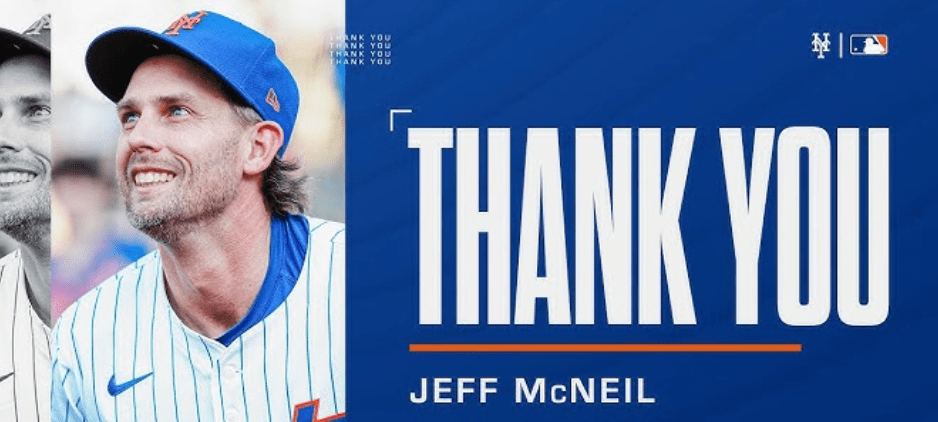
The writing was on the wall that the core group of players who defined the Mets clubhouse over the last seven years was no longer the answer for the future. What felt sudden was really a slow domino effect that began with the trade of Brandon Nimmo. After additional trades and free-agent departures, the once-beloved core faded into memory for the Mets fanbase.
Jeff McNeil was the final piece of that already weakened foundation. His trade to the Sacramento Athletics officially closed the book on an era. McNeil’s time with the Mets featured both highs and lows, but he will be remembered for his versatility and the impact he made both at the plate and in the field.
McNeil burst onto the scene with three straight seasons hitting above .300. His breakout year came in 2019, when he hit 23 home runs, drove in 75 RBIs, scored 83 runs, and collected 133 hits. He posted a .318/.384/.531 slash line, good for a 143 OPS+ and 5.2 WAR. His best season came in 2022, when he led the Mets in WAR, finished with 174 hits, 62 RBIs, and 73 runs, and posted a .326/.382/.454 slash line with an .836 OPS and a 140 OPS+. He won the NL batting title, becoming the first Met to do so since José Reyes in 2011, and recorded his second career season with over 5 WAR.
McNeil leaves the Mets with a career WAR of 23, ranking inside the franchise’s top 25 all-time, between Pete Alonso and Howard Johnson. Across eight seasons and 923 games, he logged 3,245 at-bats, 920 hits, 80 home runs, 432 runs scored, 367 RBIs, and 37 stolen bases, with a career slash line of .284/.351/.428 and a 117 OPS+. He earned two All-Star selections, a Silver Slugger, and a batting title, while wearing three different jersey numbers along the way.
It’s a shame that it ended this way. On paper, McNeil made sense to keep. He was a cheap and versatile veteran, making roughly $15 million per year with team control through 2027. For a front office focused on value, he looked like the type of player you keep during a transition.
But baseball decisions aren’t always about numbers. Winning matters. Slash lines matter. Counting stats matter. But sometimes clubhouse culture becomes the problem teams feel they need to address. The issues weren’t new. Dating back to 2021, when Francisco Lindor first joined the team and pushed for infield alignment and shifting work, McNeil’s strong refusal raised questions about buy-in. That didn’t erase his talent or his production, but it showed he wasn’t always the easiest fit when it came to defensive alignment and team direction.
That shouldn’t take away from what McNeil brought to the table. He was almost as valuable as the next guy up for the Mets. He played nearly every position besides catcher and pitcher and gave the team flexibility year after year. Teammates don’t have to be best friends, and they don’t have to admire everyone in the room. That’s normal. What matters is showing up when it counts. While McNeil did that at times, it clearly wasn’t enough to prove his worth in the eyes of David Stearns.
Stearns committed to cleaning up the clubhouse and revamping it from the inside out. Sometimes that means moving on from productive players in favor of a different direction. Unfortunately, that process left McNeil on the outside looking in.
McNeil wasn’t perfect, but he showed up, played hard, and provided real value to the Mets for nearly a decade. Sometimes players become collateral damage when an organization decides it needs change.
Thank you for everything, Jeff, and best of luck with the Athletics.
 MLB Prime Time Baseball.
Leave a comment