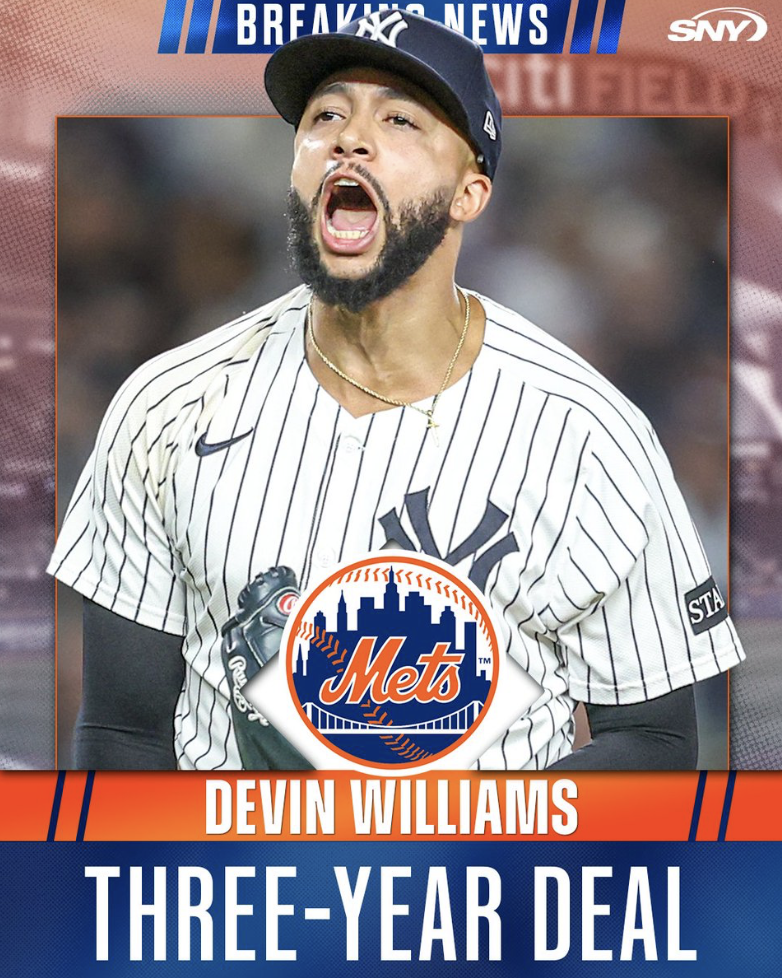
It was reported late last night that Devin Williams signed with the New York Mets on a three-year, $45 million deal with a $6 million signing bonus. With no shock to anyone, Mets Twitter is in a full-blown rampage, worried that the Williams signing is an overpay. Like any signing or trade the Mets make, there will always be controversy and outrage among the fans, but with the offseason just starting and all the big-name players still available, there’s nothing to worry about and no reason to press the panic button yet.
Obviously, everyone knows the numbers Devin Williams put up in 2025 were far from his career average, but there are still a lot of things to look forward to this upcoming year. One thing to keep in mind that contributed to Williams’ bad performance is the immediate jump from a small-market team in Milwaukee to a large-market team in the Bronx. Although there is no excuse that can fully defend the numbers he put up last year, it’s important to remember that he never had time to adjust to New York City and was thrown directly into one of the highest-pressure stadium environments in baseball, where he clearly struggled.
Every great star takes time to adjust to playing in a bigger city and a more intense climate. It has nothing to do with the kind of player they are or whether they’re on a downfall. Devin simply needed time to adapt to New York City and to playing under one of the most demanding fanbases on the East Coast, where even small struggles lead to immediate scrutiny.
On the surface, Devin Williams didn’t perform well last season. He had a -0.3 WAR, a 4–6 record, a 4.79 ERA in 62 innings, and recorded 18 saves while striking out 90 batters. This is clearly an outlier and a stain on his overall career metrics, and I’m not worried one bit that he will bring this performance into Queens for the 2026 season.
A two-time All-Star, two-time Trevor Hoffman Award winner, and the 2020 Rookie of the Year, it’s no surprise that Devin Williams has extensive experience at the top of his game. A career 2.45 ERA in 308 appearances proves exactly that, as he has been nothing short of dominant throughout his time with the Brewers and the Yankees.
Through August 8th, Williams had a 5.73 ERA in 44 innings, but after August 8th he did not allow a single home run, including the postseason, and finished with 23 innings of 2.05 ERA baseball and a 4.2 percent walk rate. Much of his season was simply bad luck, as his advanced statistics stayed near his career norms. An ERA+ that was 15 percent below league average isn’t great, but Williams still posted a 2.68 FIP, right around his career average of 2.45. FIP, or Fielding Independent Pitching, measures a pitcher’s performance based only on outcomes they can control: strikeouts, walks, hit-by-pitches, and home runs. It removes the impact of balls in play, assuming pitchers have little control over whether those batted balls turn into outs. A FIP around 3.00 is considered elite, and by those metrics, nothing has changed in the star talent of Devin Williams. It was simply the pressure and too many pitches left over the plate that opened the door for big innings.
In 2021, Devin Williams had an 8–2 record with a 2.50 ERA and was 66 percent better than league average, with a FIP of 2.82. Yes, he struggled for much of last year and gave up more earned runs than usual, but if you remove balls in play, he was close to his career norms. Luck truly plays a role in a pitcher’s outcomes, and even the most dominant players can get shaken at times. It’s normal — they’re human.
Relievers, especially closers, are very hit-or-miss when it comes to maintaining performance after being traded midseason. Take Ryan Helsley, for example. He was dealt from the Cardinals to the Mets at the last deadline, and even after finishing 2024 with 49 saves, he struggled in his new city with a 7.20 ERA in 20 innings. I’m not saying that will happen to Williams again, but I’m also not saying mistakes won’t happen this year, and that alone is no reason for an outcry. Reuniting with former Brewers president of baseball operations David Stearns could be incredibly beneficial for Williams and help him return to form. I also think he’ll be much more relaxed after spending a full year under New York’s spotlight and moving to the better half of the baseball town.
Now it’s time to address the elephant in the room: Edwin Díaz. I know everyone is demanding that Stearns and Cohen immediately re-sign Díaz and give him what he wants, and I agree. Edwin Díaz is one of the most valuable parts of the Mets franchise. Beyond his on-field performance, the sheer excitement and hype he brings closing games with “Timmy Trumpet” does wonders for the Mets both financially and across baseball.
It’s pivotal that the Mets find a way to bring Sugar back and pay him what he rightfully deserves to again be the highest-paid closer in baseball. Who cares what the fans say? He deserves it. If it comes down to choosing between the Dodgers or the Mets, we must provide Díaz with a blank check to keep him in Queens. I’m confident the Mets will reach a deal, especially since the sides aren’t far apart, with the Mets offering around $19–20 million annually for three years while Díaz’s team is seeking five. Eventually, one side will make the move to finalize the contract.
A combination of Devin Williams setting up for Edwin Díaz is music to my ears. It’s the bullpen equivalent of pairing Max Scherzer and Justin Verlander in the rotation, except the hype actually matches their current performance and both are still in their prime. I believe in the Mets front office and in their ability to build an ultra-competitive roster for 2026 and beyond. It’s important not to let this opportunity slip away. Take advantage and keep one of the best closers in the league.
Struggling in New York during a first season is more common than people realize. At one point, fans wanted to trade away Edwin Díaz and called his acquisition one of the worst trades in Mets history until he turned things around in 2020 and hasn’t looked back since. Let’s not forget the complete 180 everyone did. When Díaz was on the mound in 2019, you had a better chance of the game being blown than the save being secured. People were stressed, nervous, and lacked confidence in the 25-year-old closer. He finished the year with 66 appearances, a 2–7 record, a 5.59 ERA, and a 74 ERA+ with a 4.51 FIP — significantly worse than Williams’ FIP last season — yet people are calling Williams washed and overpaid. Ironically, Díaz put up those numbers his first year and is now the highest-paid closer in baseball.
All I’m saying is that it’s natural to struggle in a first year and not match your career norms. Both Williams and Díaz had excellent seasons before being traded to New York, and after rough years, both players showed they could return to form. Since 2020, Díaz has been the star of the ninth inning and hasn’t let one season define him. He knew 2019 was a fluke. Now it’s time for Williams to follow that same path. He’s adjusted to New York, and now he’s ready and hungry. I have a lot to look forward to for the 2026 season, but one thing is for sure: if Sugar and the Airbender line up for the eighth and ninth, the Mets might never lose a game again.
 MLB Prime Time Baseball.
Leave a comment